Shared Utility Infrastructure: Understanding Joint Use in Power, Safety, & Communications Spaces
Utility poles are the foundation for joint use operations between pole owners and service providers that attach equipment to those field assets. As electric power, telecommunications, broadband, and CATV companies increasingly work with pole owners to provide services to wider areas, they must work together to ensure pole attachments meet compliance and safety requirements.
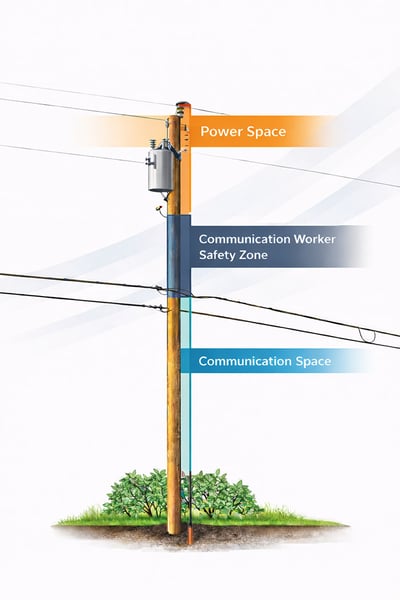
Strong joint use collaboration starts with understanding the three primary areas of the utility pole: the power space, communication worker safety zone, and the communications space. By recognizing the distinct purposes each section serves on the pole, as well as the regulations and attachments for each, asset owners and attachers can ensure safe, collaborative joint use operations.
For an expert perspective, we spoke with Chris Burton, Project Manager at Alden Systems. Drawing on his field experience and deep knowledge of compliance standards and pole attachments, here’s a clear breakdown of how these sections are structured, the regulations that govern them, and what’s typically found on each.
The Power Space
Also known as the electrical supply zone, the power supply space is located in the uppermost area of a pole. For safety reasons, the highest voltages live in this location, preventing workers and the public from interacting with dangerous live wires.
True to its name, the power space provides high-voltage power through various attachments and wires.
In this space, you may find:
-
Primary conductors, which are wires without protective covering that transmit high-voltage electricity.
-
Transformers, which reduce high-voltage power into levels suitable for residential and commercial use.
-
Secondary distribution cables, which send electricity out to associated buildings and homes and are coated in a protective layer.
-
Insulators, which support primary conductors and prevent electricity from running down the pole.
-
Capacitors, which store electrical energy.
Because the power supply space is home to high-voltage attachments, only authorized electrical workers with specialized training are permitted to work in or above this section of the utility pole.
The Communication Worker Safety Zone
The Communication Worker Safety Zone is a buffer between the power and communication spaces. Located directly below the power space, this section of the pole protects communication workers from dangerous voltages and separates communication lines from power lines.
Two National Electrical Safety Code (NESC) rules dictate what counts as the worker safety zone:
-
Rule 235C notes that utility poles must have a 40-inch clearance between wires, conductors, and cables in the power supply space and the communications space.
-
Rule 238 notes that supply conductors must be at least 30 inches apart from communications equipment.
The Communications Space
The communications space is the lowest of the aerial attachment space available on the pole, located directly beneath the Communication Worker Safety Zone. Communication attachments must also maintain minimum clearance above the ground to maintain public safety. Pole attachments in this area provide communities with services such as:
- Telephone
- Fiber optic
- Cable television
- Broadband
- Traffic signals
- Antennas
As the cables move away from the pole, the NESC also outlines mandatory minimum vertical space between the lowest sag point of all aerial communications attachments and the ground.
Some examples of vertical clearance considerations:
- Communication Lines over pedestrian-only areas, such as sidewalks and yards that aren’t accessible to vehicles, must have a minimum vertical ground clearance of 9.5 feet.
- Communication Lines over roadways must have a ground clearance of 15.5 –18 feet.
- Communication Lines over railroads must have a ground clearance of 23.5 feet.
Improving Joint Use Asset Management with Alden ONE
The three sections of a utility pole, as well as their respective compliance requirements, are put in place to facilitate safe, effective joint use operations. Understanding the nuances of each space is critical to ensuring worker and public safety, preventing pole violations, and overloaded poles.
A centralized system like Alden ONE enables pole owners and attachers to coordinate joint use work and manage assets collaboratively. With automated workflows and real-time reports, Alden ONE empowers teams to effectively optimize utility management.
Reach out anytime to learn how the advanced Alden ONE platform can facilitate better, safer joint use collaboration.
FAQ About Utility Pole Spaces & Joint Use Asset Management
Where on the utility pole do the power, communication worker safety zone, and communications spaces sit?
The power space, which holds the highest-voltage lines, sits at the top part of the utility pole. The communications zone refers to the lowest cables on the utility pole, which must meet minimum clearance requirements above the ground. The communication worker safety space is a minimum of 40 inches of space that sits between the power supply and communications zones.
Why is the Communication Worker Safety Zone important?
The Communication Worker Safety Zone, which sits between the power supply and communications spaces, is critical to protecting communication workers from potentially dangerous situations. With a minimum 40 inches of space, the worker safety area also separates the highest-voltage lines from the communications attachments.
Why do pole owners and attachers need to meet minimum spatial requirements?
It’s vital that pole owners and asset-attaching companies follow spatial requirements because joint use violations can result in safety hazards, potential fines or worse. Spatial requirements include required distance between the sections of the utility pole and required ground clearance of the lowest-hanging lines in the communications space.
How does Alden ONE support joint use operations?
Alden ONE allows pole owners, attachers, and their engineering partners to effectively collaborate and coordinate joint use work within one centralized source of truth. Teams can handle attachment permitting, asset management, and gain business and operational intelligence from the Alden ONE platform, while meeting compliance-related timelines and requirements.