Keep Joint Use Work On Schedule with Alden ONE ePay

As part of our ongoing Conference Blog Series, this month we are highlighting "ePay Everywhere in Alden ONE," a session presented by Customer Success Account Manager Dianne Costello that focused on a common point of friction in joint use work: payment delays.
For joint use work, payment is not simply a finance step. Payments are part of the operational path that advances utility work, ensuring regulatory timelines are met.
When a permit to attach (PTA) application fee, field survey fee, make-ready acceptance payment, or other billable item is handled manually with paper checks, work can slow down while teams wait…and wait.
Delays can show up in familiar ways:
-
Approvals have to wait for payment to be received.
-
Construction starts are held until payment receipt is confirmed.
-
Joint use teams chase after screenshots, emails, and phone calls.
-
Finance teams have to reconcile payments across disconnected records.
-
Attaching companies must wait to take their next steps in the field, potentially delaying service deployments.
ePay inside Alden ONE is designed to reduce that friction by bringing the ability to make and collect payments directly within the workflows where the joint use processes are already being managed.
What ePay Brings into the Workflow
Alden ONE’s ePay functionality offers integrated electronic payment capability embedded within Conversation workflows. Instead of collecting payments through the typical manual process, Alden ONE Pro clients can choose to insert payment steps at any defined point in any workflow.
This means payment happens when it is required. Not after a separate invoice is created. Not after an email chain. Not after someone tracks down a receipt.
An example: For a Permit to Attach request, Alden ONE Pro clients may choose to collect the application fee at the beginning of the permitting process. As soon as payment is confirmed, attachment permitting moves forward without delay.
Another example is make-ready work. Payments can be handled when the attaching company accepts make-ready costs, so that construction authorization can resume without waiting on a separate, manual invoicing process.
The value is simple: Payments occur at the right step, in the right place, with the right visibility for all key stakeholders.
Why This Matters for Joint Use Teams
When payments are handled separately, teams lose visibility and momentum. Has the fee been paid? Was the receipt sent to the right person? Does finance have the information it needs? When can the process continue? It’s exhausting and time-consuming.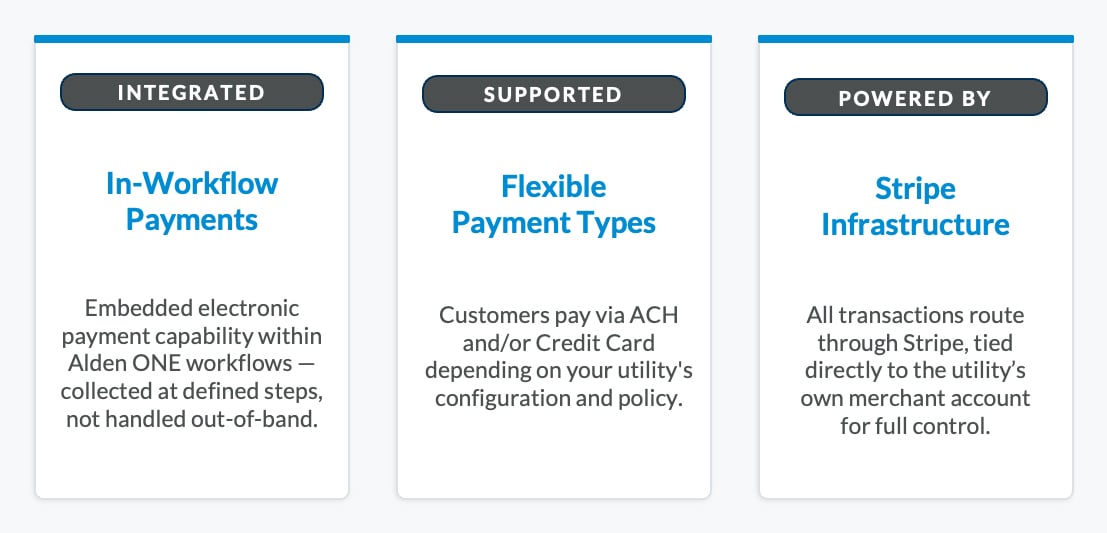
Alden ONE ePay answers those questions. Payment status is visible in the Conversation, so all necessary parties involved can immediately see whether a billable item is paid or not paid.
This ensures our clients can move from reactive payment follow-up to workflow-based payment confirmation, quickly viewing when payment is received, so the next step can move forward.
The Benefits of Using ePay
ePay helps reduce payment-related work stoppage, provides transparency to all parties regarding status, and eliminates manual follow-up, creating a more predictable experience across projects.
For the Asset Owner
Fewer payment-related bottlenecks in your joint use processes.
For Attaching Companies
A more consistent payment experience. Reduced interruptions. Clearer next steps.
For Finance Teams
Less manual reconciliation. Better reporting.
What Changes & What Stays the Same
ePay changes how payments are collected but does not change the company’s approval process. Alden ONE users may choose to pay using the payment types configured by the asset owner/Pro client, including ACH, credit card, or both.
Alden ONE generates an invoice for each ePay billable item, helping connect payment activity to the work it supports. Each company’s existing approval and attachment decision-making processes remain in place, while ePay powerfully removes the manual paper chase.
Secure Payment Data Handling
Another key point is how payment data is handled: Alden does not store credit card information or ACH banking details. Sensitive payment information is handled through Stripe’s PCI compliant infrastructure.
Alden ONE stores transaction reference information for simplified tracking, support, and reconciliation, never raw credit card or banking credentials.
Teams manage payment visibility inside Alden ONE, while sensitive payment details remain within Stripe, the secure payment processing environment. This distinction is important for many areas including finance, accounting, IT, regulatory compliance, and security stakeholders.
Visibility for Finance & Operations
When using ePay, payment status is readily visible, so operations teams can quickly understand when work can either begin or resume. Transaction identifiers and Conversation numbers support tracking, while remittance reporting helps finance reconcile payments without relying on disconnected receipts or cross-referencing multiple systems.
Companies may align payout cadence with their internal finance processes. Payouts can be scheduled to match billing cycles and general ledger close dates, with aggregated payouts helping reduce the need to reconcile each individual transaction manually.
Planning an ePay Rollout: Alden’s Team Is Here to Help
A successful ePay rollout depends on thoughtful decisions prior to launch. This is where Alden’s role becomes especially important. The word Alden means “wise old friend,” and that meaning reflects how our team works with, and for, our clients. Each organization has its own policies, fee structures, finance requirements, and partners. Our team works directly with you to help think through the process so that ePay is configured to support your company’s processes rather than complicating them.
Many clients choose to begin with a focused pilot program in a single workflow to validate the ePay process before expanding. Attachment permitting fees and make-ready acceptance payments are strong starting points because they are high-volume, highly visible workflow steps where payment delays have an immediate impact.
After the process is validated, ePay may be expanded across additional workflows where it makes sense for your business.
Tips to Get Started
- Start small, then scale. One or two high-impact workflow steps can show how ePay works before expanding more broadly.
- Involve Finance teams early. Accounting teams need time to review merchant account setup, Stripe configuration, payout reporting, and reconciliation needs.
- Payout cadence should align with your finance processes. When payout timing is coordinated with billing cycles and close dates, reconciliation becomes much easier.
- Workflow placement matters. Any payment step must support the process, not create confusion. We recommend that operations and finance be part of those decisions.
- Fee policy must be decided before launch. Everyone must understand upfront what they are paying and why. Transparency is the key to success.
ePay Is Available for Alden ONE Pro Clients
The takeaway here is that ePay is not merely a payment feature: ePay offers a business improvement that helps reduce work delays and improve internal and external visibility, all while supporting a more predictable joint use process.
Looking for a better way to handle joint use payments? Whether your team would like to reduce approval delays, simplify finance handoffs, or help create a better experience for attaching partners, ePay offers a way to collect payments, as well as allowing their partners to make payments all inside one centralized platform. Fill out the contact form to start the conversation.